


Lagos, Ogun Capture Majority of Nigeria’s Industrial Investment as Regional Gap Widens
By GLEBM News Desk
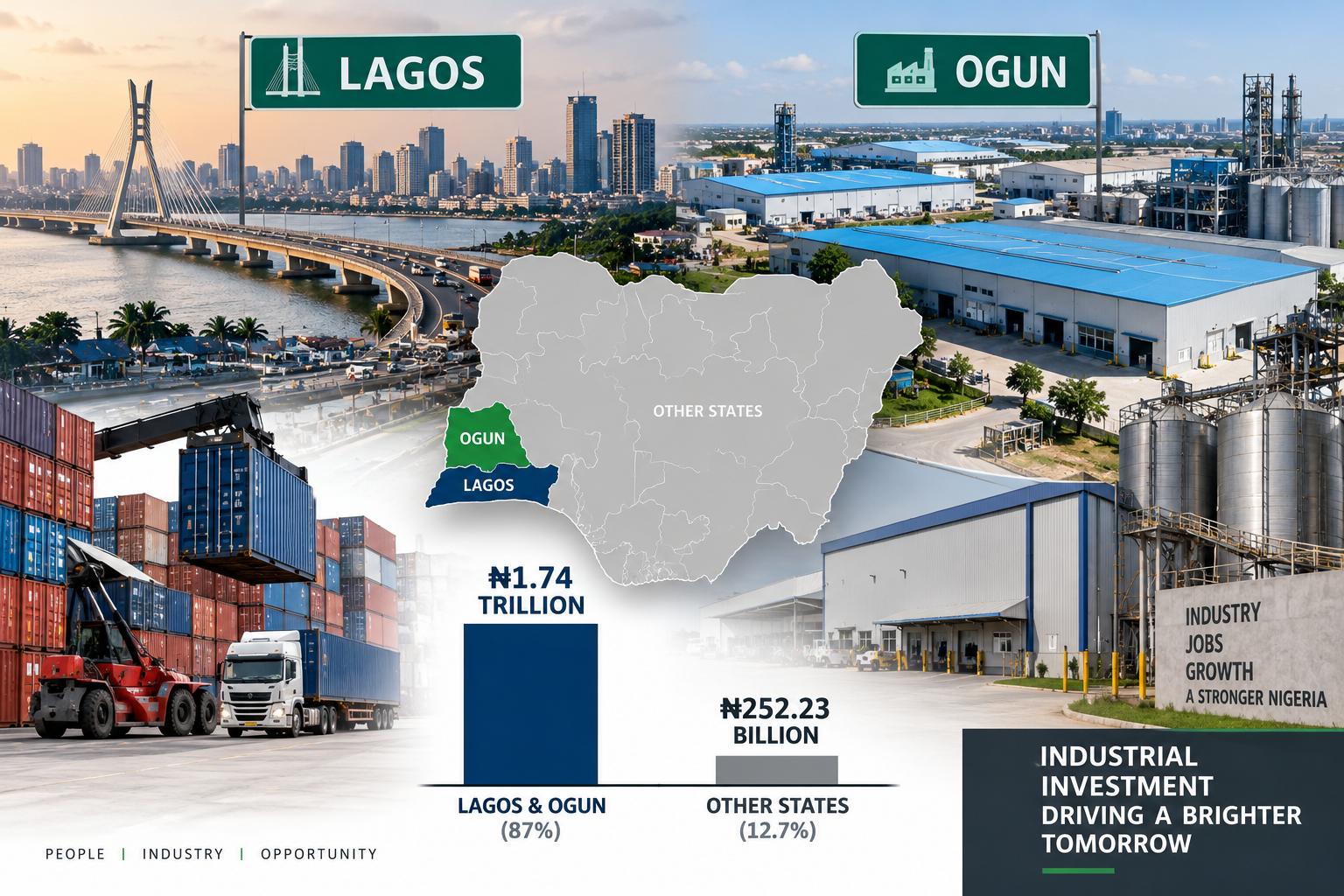
Industrial investment in Nigeria remains heavily concentrated in Lagos and Ogun states, with the two states attracting about ₦1.74 trillion of investment between 2024 and 2025, according to industry data.
The figure represents about 87 per cent of total industrial investment recorded across the country during the two-year period, highlighting the continuing dominance of the Lagos-Ogun corridor as Nigeria’s principal manufacturing and industrial hub.
The remaining 34 states collectively attracted approximately ₦252.23 billion, accounting for only about 12.7 per cent of the total investment.
The distribution of investment points to the importance of infrastructure, market access, transportation and proximity to major commercial gateways in determining where manufacturers choose to establish or expand operations.
Lagos has a combination of factors that make it attractive to investors, including a large consumer market, established industrial clusters, access to major seaports and international air links. Ogun, meanwhile, has benefited from its proximity to Lagos and the availability of industrial land along major transport corridors.
A number of major manufacturers have established or expanded operations within the two-state corridor, reinforcing its role as a major centre for production and distribution.
However, the concentration also raises questions about the ability of other parts of the country to attract comparable levels of industrial investment.
Businesses operating farther away from the major ports can face higher logistics costs when importing raw materials or moving finished products to markets. Insecurity and inadequate transport infrastructure can further increase the cost of establishing manufacturing facilities outside established industrial centres.
Industry stakeholders have therefore continued to call for stronger infrastructure investment, improved transport links and more efficient ports in other parts of the country.
The development of industrial clusters outside Lagos and Ogun could potentially spread employment opportunities and economic activity while reducing pressure on the existing manufacturing corridor.
For investors, however, location decisions are largely influenced by the total cost of doing business. Reliable electricity, roads, ports, security, access to skilled workers and proximity to consumers all affect the viability of manufacturing projects.
The investment figures consequently provide another indication of the relationship between infrastructure and private-sector development in Nigeria.
As the Federal Government and state governments seek to attract more domestic and foreign investment, the ability of states outside the traditional industrial corridor to provide competitive business environments will remain an important factor in determining how evenly industrial growth is distributed.