



World Bank Urges Nigeria to Put Job Creation at the Centre of AI and Investment Reforms
By GLEBM News Desk
Nigeria has been urged to make employment generation a central objective of its technology and economic reforms as the World Bank and International Monetary Fund (IMF) warn that the rapid adoption of artificial intelligence could widen inequality and weaken opportunities for entry-level workers.
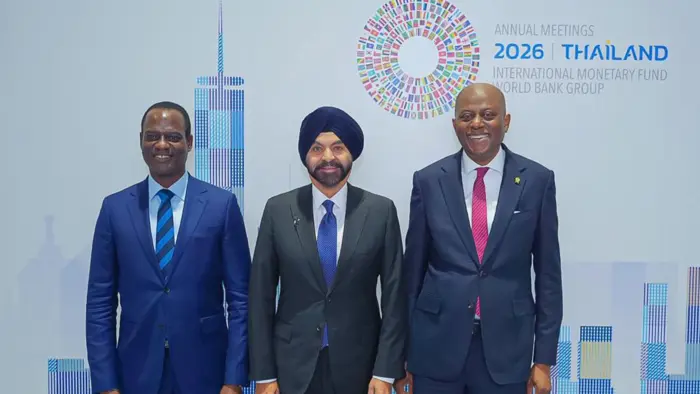
The warning came as Nigeria’s delegation, led by the Minister of Finance and Coordinating Minister of the Economy, Taiwo Oyedele, engaged international financial institutions and investors during the ongoing IMF and World Bank annual meetings in Bangkok, Thailand.
The discussions have placed the relationship between technology, investment and employment at the centre of the development agenda, particularly for emerging economies with large populations of young people entering the labour market.
World Bank Group President Ajay Banga called for practical applications of artificial intelligence that could improve productivity and create employment opportunities, particularly in agriculture, primary healthcare, tourism, infrastructure and manufacturing.
He argued that governments should not view technology adoption as an end in itself but should focus on whether it improves economic output, supports businesses and expands opportunities for people to earn a living.
“The bank’s entire focus has moved towards that over the last few years,” Banga said, explaining that infrastructure projects, schools, healthcare facilities and skills centres should be developed with job creation in mind.
Banga also stressed that private businesses must remain central to employment generation, noting that the private sector accounts for an estimated 75 to 85 per cent of jobs in many economies.
For Nigeria, the message comes as policymakers seek to attract investment, expand productive capacity and improve economic performance following significant fiscal and foreign exchange reforms.
However, the growing use of artificial intelligence introduces new challenges. Although automation can reduce costs and improve efficiency, it can also displace certain tasks and reduce demand for some entry-level positions if businesses adopt the technology without preparing workers for changing job requirements.
Singaporean President Tharman Shanmugaratnam warned that economic growth alone would not guarantee sufficient employment. He cited experiences in China and India to illustrate how economies can expand without creating enough quality jobs for their populations.
“Growth is going to be critical to secure good jobs, but growth is not itself going to be sufficient to achieve those good jobs,” he said.
Tharman identified manufacturing, green energy and healthcare as sectors with potential to create well-paid employment, while calling for stronger skills development to help workers adapt to changing economic conditions.
IMF Managing Director Kristalina Georgieva also raised concerns about the implications of artificial intelligence for public finances. If technology changes the balance between labour income and returns on capital, governments may need to reconsider how they generate revenue and finance social support.
The discussions carry important implications for Nigeria’s investment strategy. Attracting capital into technology and infrastructure will be more beneficial if investment also strengthens local businesses, creates jobs and equips workers with relevant skills.
For businesses, the challenge will be to deploy AI in ways that increase productivity without unnecessarily excluding workers. For government, it will require policies that connect investment incentives with skills development, infrastructure expansion and productive employment.
The message from the Bangkok meetings is that technological progress and economic growth must translate into opportunities for workers if developing economies are to secure broad-based and sustainable prosperity.

