


ILO Backs BRICS Agenda on Social Protection, Women’s Employment and Future-Ready Labour Markets
Labour ministers endorse new cooperation framework to strengthen skills development, formal employment and worker protection across BRICS nations
By GLEBM News
The International Labour Organization (ILO) has endorsed a new labour and employment agenda adopted by BRICS countries, describing it as a significant step towards expanding social protection, increasing women’s participation in the workforce and preparing workers for the rapidly evolving global labour market.
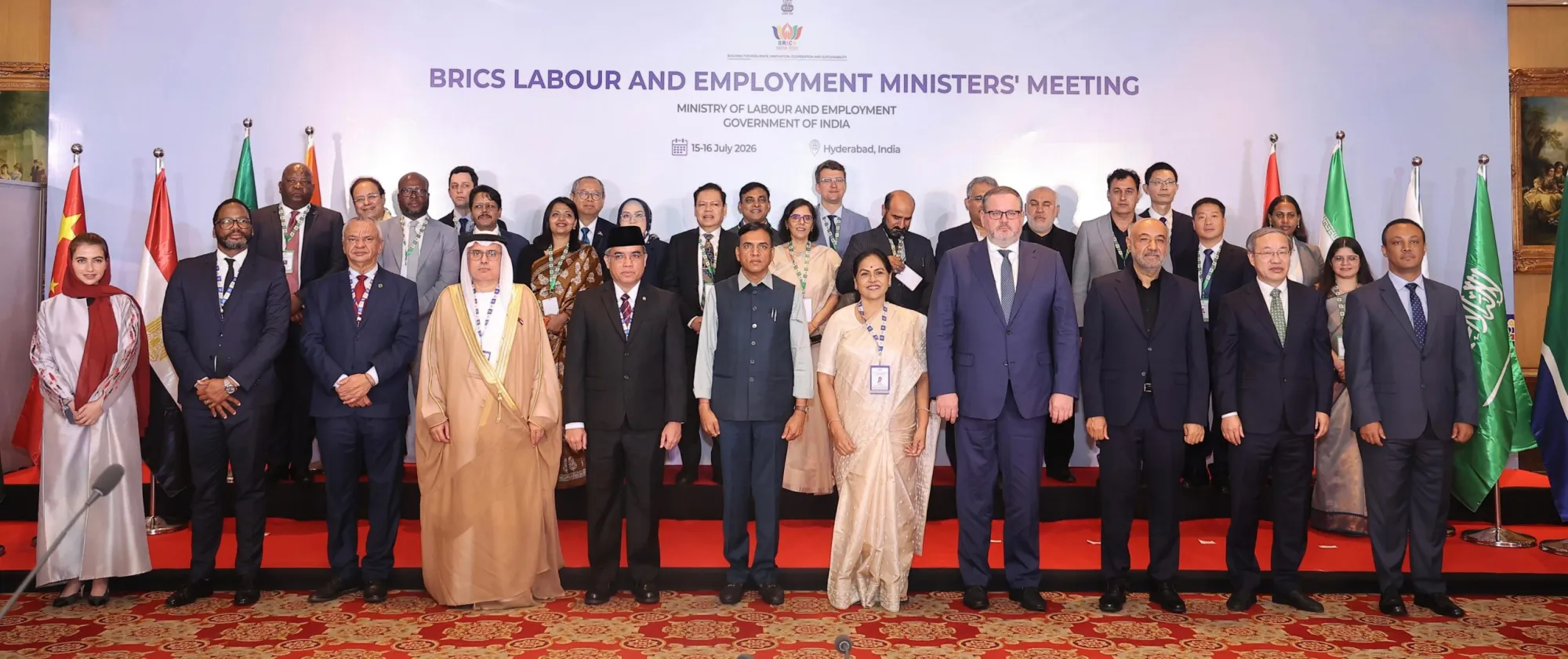
The endorsement followed the BRICS Labour and Employment Ministers’ Meeting (LEMM) held under India’s 2026 BRICS Presidency, where ministers from member countries agreed on a range of initiatives aimed at strengthening labour markets through innovation, digital transformation and inclusive economic growth.
Held under the theme “Building for Resilience, Innovation, Cooperation and Sustainability,” the meeting placed particular emphasis on creating digitally empowered labour markets capable of responding to changing employment patterns while protecting workers’ rights.
Addressing the ministerial meeting through a video message, ILO Director-General Gilbert F. Houngbo commended India’s leadership for elevating labour and employment issues within the BRICS agenda at a time when countries are navigating profound changes in the world of work.
“The priorities identified could not be more timely,” Houngbo said, noting that global labour markets are being reshaped by digital technologies, demographic shifts and new forms of employment.
A major outcome of the meeting was the commitment by BRICS countries to expand social protection systems while promoting the formalisation of labour markets. Ministers agreed to pursue broader social security coverage in line with national priorities, supported by sustainable financing mechanisms and closer bilateral and multilateral cooperation.
The ILO also praised India’s progress in extending social protection to a large proportion of its population, describing the country’s experience as a valuable model that could be shared with other developing economies through South-South cooperation.
Another key area of focus was women’s economic empowerment. Labour ministers discussed measures to improve women’s participation in the workforce by investing in the care economy, expanding access to education and lifelong learning, promoting equal pay, tackling workplace violence and harassment, and supporting women-led enterprises.
According to ILO estimates, the adoption of universal care policies across BRICS member countries could create approximately 165 million jobs by 2030, while also reducing gender inequalities and boosting economic productivity.
Recognising the growing demand for new workplace competencies, the ministers also agreed to strengthen collaboration on skills development, labour market intelligence and workforce planning.
The discussions centred on improving skills forecasting and ensuring that education and training systems are better aligned with opportunities emerging in digital technology, green industries and the care economy.
As part of this effort, ministers took note of an ongoing ILO feasibility study being conducted in partnership with India and Brazil to develop an International Reference Classification of Occupations, a framework intended to improve international cooperation on workforce development in emerging sectors.
The meeting further examined how digital technologies can be deployed to strengthen labour market governance and improve access to social protection.
Joint research by the ILO and the International Social Security Association (ISSA) identified digital registration systems, electronic contribution collection, digital identity verification, mobile service delivery, online benefit management, career guidance platforms and digital job-matching services as important tools for expanding worker protection.
However, the organisations stressed that digital transformation must remain inclusive and underpinned by strong governance, institutional capacity and data protection measures.
“Well-governed digital transformation can expand decent work opportunities and ensure that innovation serves people, not the other way around,” Houngbo said.
He also highlighted the recent adoption of ILO Convention No. 193 on Decent Work in the Platform Economy, describing it as an important milestone in establishing international labour standards for workers engaged in digital platform and gig economy employment.
In a significant institutional development, BRICS ministers adopted BRICS CONNECT — the BRICS Cooperation Network for Capacity Building, Employability, New Skills and Technology.
The initiative is expected to serve as a collaborative platform for member countries to strengthen cooperation in social security administration, skills development, women’s workforce participation and digital transformation. It builds on the existing BRICS Social Security Virtual Liaison Office (BRICS VLO) while creating broader opportunities for knowledge exchange, capacity building and South-South cooperation.
The meeting concluded with ministers expressing appreciation for the technical support provided by both the ILO and ISSA and reaffirming their commitment to continued collaboration in advancing decent work, inclusive labour markets and sustainable employment policies across BRICS member states.
The BRICS intergovernmental organisation currently comprises Brazil, Russia, India, China, South Africa, Egypt, Ethiopia, Iran, Saudi Arabia, the United Arab Emirates and Indonesia, representing a significant share of the global economy and labour force.

This casino has such a vibe! I feel lucky every time I log in. The graphics are amazing and the gameplay is very immersive. swertewincasino
The best place to bet if you are looking for fairness and speed. I had a huge win last weekend and the withdrawal was instant. Love phmegabet