


World Bank Pushes Digital Agriculture Data System to Power AI-Based Farming in Nigeria
By GLEBM News Desk
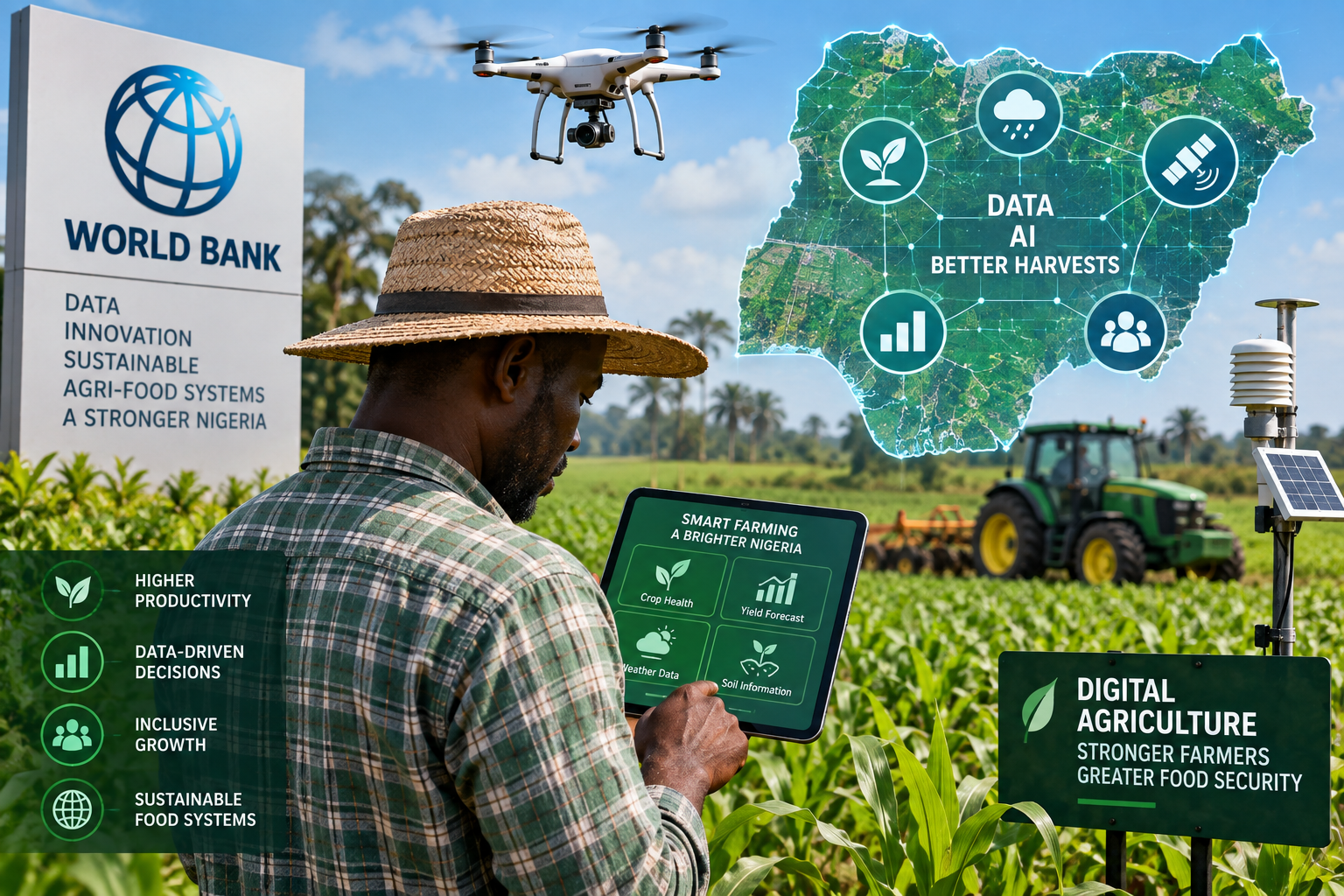
Nigeria could use its existing agricultural statistics infrastructure as the foundation for a new generation of digital farming services, with the World Bank advocating integrated data systems capable of supporting artificial intelligence applications.
The proposed approach would bring together information collected from agricultural surveys with satellite imagery, weather records, soil maps, market information and other datasets to improve decision-making across the farming sector.
The World Bank said Nigeria is among 10 African countries where recent agricultural surveys have generated extensive information on farms, crops, production, livestock, inputs, farming practices and agricultural households.
Such information could provide the ground-level data required to develop more accurate digital agricultural tools.
Artificial intelligence is increasingly being explored for applications including crop mapping, yield forecasting, pest surveillance, drought monitoring and targeted advice to farmers. However, the effectiveness of these systems depends heavily on the quality and availability of local data.
Satellite imagery can provide information about vegetation, weather and land conditions, but it cannot independently capture every detail of what is happening on individual farms.
Agricultural surveys can help fill that gap by providing information about what farmers plant, the inputs they use, the quantity they produce, losses encountered and their access to irrigation, finance, extension services and markets.
Combining those datasets could allow policymakers and technology developers to build more precise models tailored to local farming conditions.
For Nigeria, the potential applications are significant because farmers operate across different climatic zones and production systems. A data system capable of identifying local conditions could support more targeted interventions instead of relying solely on broad regional estimates.
The proposed digital infrastructure could also improve the monitoring of crop losses and weather-related risks, helping government agencies and farmers respond more quickly to drought, flooding, pests and other threats.
The World Bank has also pointed to the importance of regional cooperation among African countries as agricultural data systems develop.
Countries could retain control of their national datasets while cooperating on common standards, methodologies and technology, potentially making it easier to develop tools that work across borders.
The approach represents a shift from treating agricultural statistics primarily as information for government reports to viewing data as infrastructure that can support practical digital services.
For farmers, the ultimate value would depend on whether the information generated through such systems can be translated into affordable and accessible services, including timely weather information, production advice, market intelligence and early warnings.
Nigeria’s agricultural transformation therefore increasingly involves not only improving physical inputs such as seeds, fertiliser and irrigation, but also building the information infrastructure needed to make farming more productive and responsive to changing conditions.